
A founder I spoke with recently had done everything right.
Smart bidding. Audience testing. Retargeting flows built and rebuilt. Landing pages optimized through dozens of iterations. They’d read the playbooks, hired good people, and followed the platform best practices closely.
Their ROAS was still declining.
What I told them is something I’ve had to say more and more often: everything they optimized is table stakes now. The platforms have automated most of it. Their competitors are running the same playbook inside the same platforms, pulling the same levers in roughly the same sequence.
The one thing that doesn’t converge is creative.
How we got here
For most of the history of performance marketing, the primary competitive advantage was media efficiency. The brands that won were the ones that got better at buying — smarter targeting, tighter audience segmentation, more precise bidding, faster optimization cycles.
That advantage was real, and for a long time it was substantial. If your team understood the platform mechanics better than your competitors, you could generate meaningfully better returns on the same spend.
Then the platforms caught up.
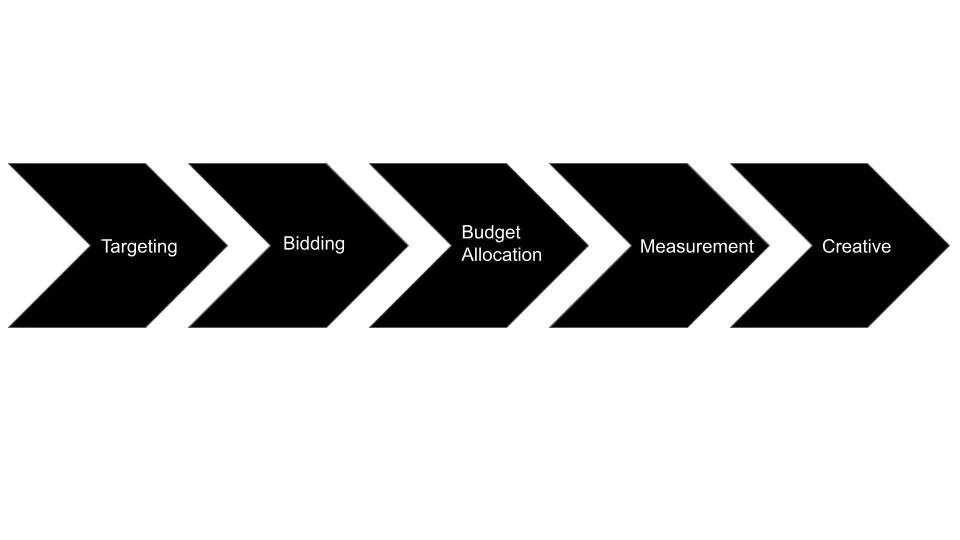
Audience targeting became algorithmic. Budget allocation automated. Bid optimization happens in real time now, continuously rebalancing toward higher-performing segments without anyone touching a dashboard. Delivery systems have gotten so good at finding the right person for a given ad that the tactical edge most performance teams spent years building has quietly been absorbed into the platform infrastructure itself.
The result is a market where operational advantages compress quickly and converge. Two brands using the same platform, targeting the same audience, with similar budgets will increasingly achieve similar delivery outcomes — regardless of how sophisticated their media team is.
That’s not a criticism of media teams. It’s a description of what mature ad platforms do: they democratize access to optimization, which means everyone reaches the floor faster and the ceiling lower than it used to be.
The one lever that doesn’t converge
Creative behaves differently from the rest of the performance stack — and it always has.
Platforms can automate how an ad is delivered. They cannot automate what the ad says, what it looks like, or whether it earns someone’s attention in the half-second before the scroll. That’s still a human problem. It’s still a strategic and creative problem. And it’s one that your competitors cannot solve by buying the same tools you’re using.
But there’s something more important happening than simply “creative is hard to copy.”
Creative isn’t just differentiated. It’s become the primary input into everything else.
When someone stops scrolling, that’s a creative decision. When someone watches past three seconds, that’s a creative decision. When someone clicks, that’s a creative decision. And every one of those decisions generates a signal — scroll behavior, engagement rate, watch time, conversion intent — that the platform’s algorithm uses to decide where to distribute your media next.
In other words: creative determines the quality of the signals your account sends. And the quality of those signals determines how well the algorithm works for you.
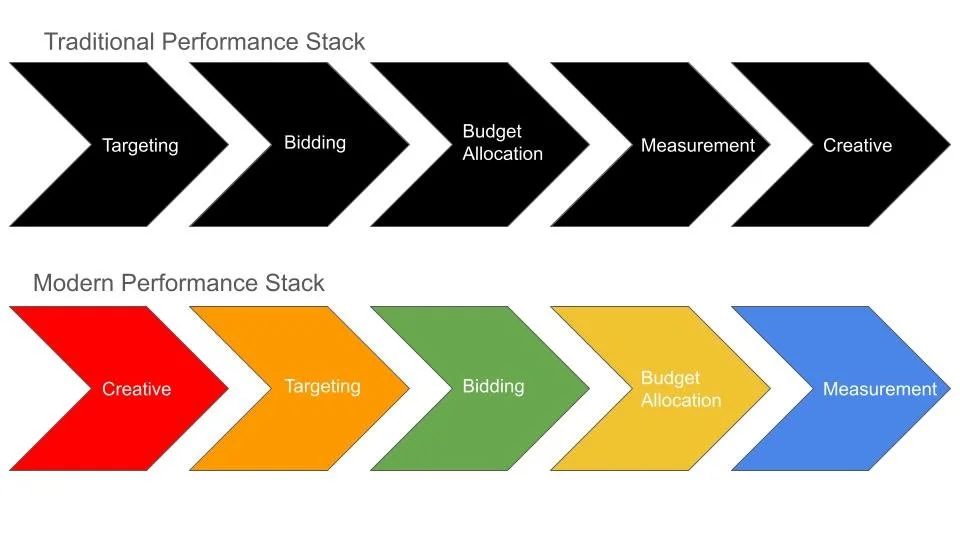
This is the inversion that changes everything. For years, creative was the last step — strategy, then media planning, then production. Creative was what you handed off after the real work was done.
That relationship has flipped. Creative is now the input. The quality of the creative determines whether the system distributes at all, at what cost, and to whom. Media strategy still matters, but it’s increasingly a function of creative quality rather than the other way around.
What most growth teams are still getting wrong
Understanding this intellectually and operating accordingly are different things. Most growth teams — even sophisticated ones — still treat creative as a production function rather than a strategic one.
They brief the creative team (or the agency) after the media strategy is set. They evaluate creative on production quality rather than hypothesis quality. They run tests that generate activity but not real learning. And when performance flattens, they reach for another targeting adjustment or a new audience segment before they ask the harder question: what is our creative actually saying, and is it earning attention?
This isn’t a failure of talent. It’s a failure of prioritization — a holdover from the era when targeting was the primary lever and creative was downstream of it.
In that world, it made sense to optimize the media first and use creative to fill in the gaps. In today’s world, that sequence produces brands that are well-optimized for declining returns.
The brands pulling away right now have reorganized around a different center of gravity. Creative is the starting point — the strategic hypothesis about what message, format, and story will resonate with a specific audience at a specific moment. Media is the mechanism for testing and distributing that hypothesis at scale. And performance data feeds back into creative strategy, so the system gets smarter with every cycle.
Creative systems vs. creative production
There’s an important distinction here that’s worth making explicit.
The answer to “creative is the last performance lever” is not “produce more creative.” Volume without learning doesn’t compound — it just accelerates fatigue and increases cost.
The real answer is building a creative system: a structured process that generates ideas, tests them deliberately, captures what works and why, and feeds that learning back into the next round of work. Over time, that system builds what we call the Creative Dividend — the compounded value that accumulates when every campaign makes the next one sharper.
This is also why creative and media need to operate as a unified system rather than separate functions. When they’re disconnected, performance signals stay in reports and never change the creative brief. When they’re integrated — when the same team is responsible for both the hypothesis and the test — the feedback loop closes and the system learns. That’s the model behind the Creative + Media Flywheel: creative informs distribution, distribution generates signals, and signals improve the next creative round.
What this means for your creative strategy
If creative is the primary driver of performance, then the question isn’t just “is our creative good?” It’s “does our creative program generate learning?”
A single great ad is valuable but fragile. A creative system that keeps producing great ads — and gets better at it over time — is a structural advantage that compounds.
That means creative strategy has to be designed for the environments where audiences actually engage. On Meta and TikTok, that means building work that’s native to the feed — not ads that interrupt, but content that earns attention within the context people are already in. Content that fits the pace, the format, and the expectations of the platform rather than fighting against them.
It means briefs that start with a hypothesis, not a production request. Testing that’s structured to answer a specific question, not just generate activity. And performance data that flows back into the brief rather than sitting in a report.
And it means treating creative as infrastructure — something you invest in deliberately and build over time — rather than a commodity input you replenish when it runs out.
The compounding edge
The brands that have figured this out don’t just make better ads. They build better systems for making ads — and those systems accumulate knowledge that their competitors can’t easily replicate.
Competitors can copy your best creative. They can match your spend. They can hire from the same talent pool.
What they can’t copy is a system that’s been learning for twelve months. The accumulated understanding of what your audience responds to, what message angles work, what formats earn attention — that’s not in any single ad. It’s in the structure of how you approach creative, how you test it, and how you use what you learn.
That’s the real compounding edge. And it starts with recognizing that creative isn’t a cost to manage — it’s the lever that’s still left.
If you want to build a creative program designed to compound over time, explore our Native Branding and Creative Production services — or get in touch to talk through where your current program stands.
Recognizing that creative is the last real lever is the first step. The second is building a system that gets better at pulling it — one that captures what works, feeds it back into the next round, and compounds that learning over time.