

Here’s a question worth sitting with:
What did you learn from your creative last quarter?
Not your best ROAS. Not your top-performing ad. Not your lowest CPA.
What you actually learned — what worked, why it worked, and how you used that to build the next round differently.
If the honest answer is “not much,” you’re not alone. Most DTC brands running paid media can tell you their results. Very few can tell you what those results taught them. And fewer still can show you how that learning changed the creative they made next.
That gap — between generating results and generating knowledge — is where growth stalls. And closing it is what the Creative Dividend is about.
What the Creative Dividend actually is
The Creative Dividend is the compounded value that builds when a brand’s creative program consistently generates learning, not just output.
The word “dividend” is intentional. A dividend isn’t what you earn when you make one good investment — it’s what you earn over time, because of a system that keeps paying. The Creative Dividend works the same way. It’s not the result of one great campaign. It’s what accumulates when every campaign makes the next one a little sharper, a little faster, a little less wasteful.
Specifically, the Creative Dividend shows up as:
Faster time-to-insight. Early in a creative program, you spend a lot of time testing things that have already been tested — you just didn’t capture the results. As learning compounds, you stop retreading the same ground. Testing cycles get shorter because you already know what doesn’t work.
Stronger creative from the first round. When each brief is built on accumulated insight rather than a fresh start, the quality floor rises. You’re not guessing at hooks or message angles — you’re building on evidence of what this particular audience actually responds to.
More durable performance. Creative fatigue accelerates when you’re running out of ideas. It slows when you’re running a system. Brands with a genuine Creative Dividend replace winning ads before they wear out, because they already know what the next iteration should say.
Resilience when the platform shifts. Algorithm changes, CPM spikes, policy updates — these hurt brands that are optimizing around a single winning ad. They hurt less when your advantage is a learning system that keeps generating new creative, because the system isn’t dependent on any one asset.
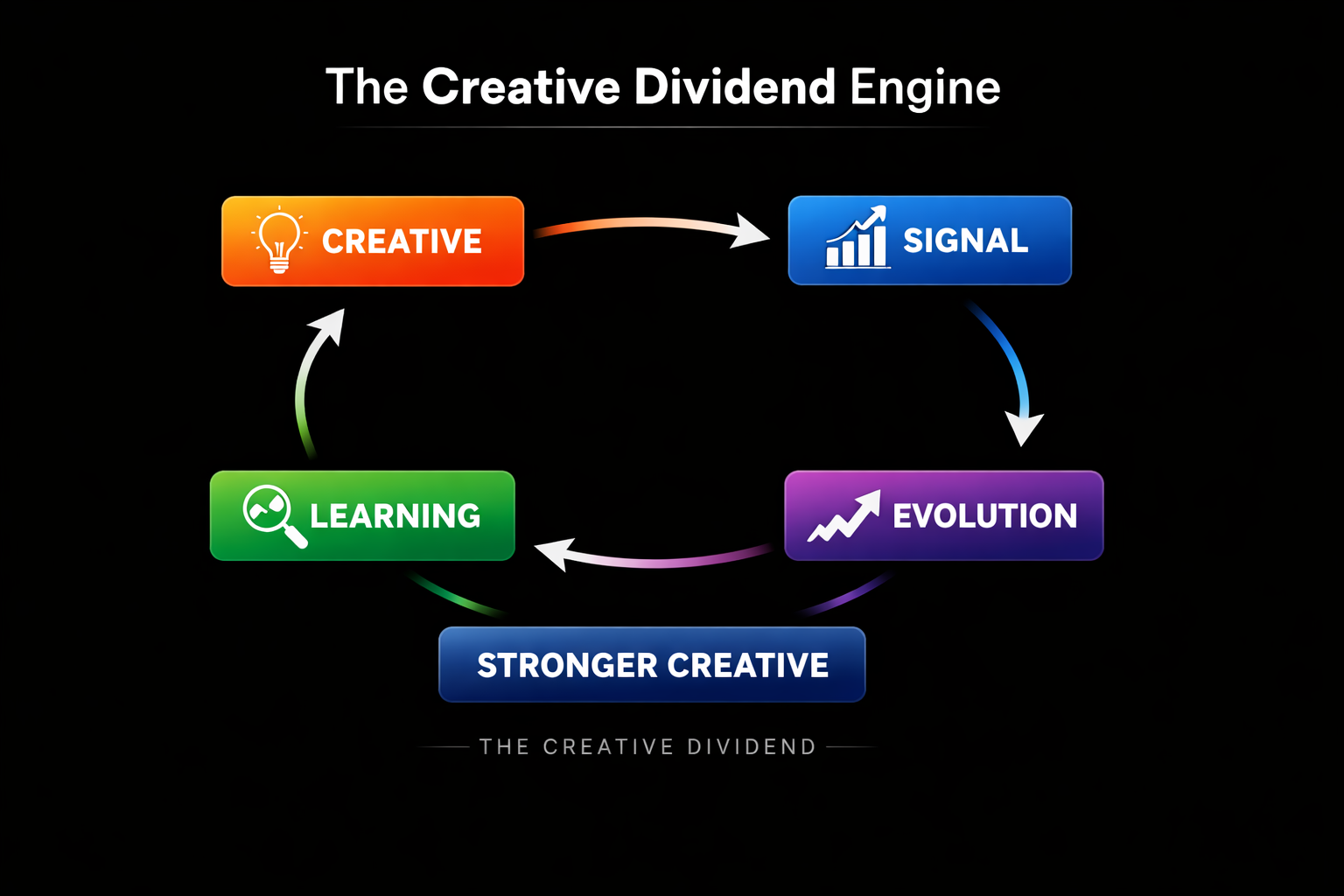
The difference between running campaigns and building a system
Most brands treat their creative like inventory. You produce a batch, run it until performance drops, then produce another batch. Each cycle starts roughly where the last one did — same brief format, same creative process, same gut-feel hypotheses about what might work.
That’s campaign thinking. It produces results, but it doesn’t compound. Every quarter, you’re more or less starting over.
Creative systems work differently. Every piece of creative is treated as an experiment with a specific hypothesis behind it. Every round of testing is designed to answer a question. Every performance signal is captured in a way that actually changes the next brief.
The compounding effect isn’t magic — it’s the result of treating creative as something you learn from rather than something you produce and move on from. Over time, the brand builds a genuine understanding of its audience: what problems they’re trying to solve, what language resonates, what formats earn their attention, what proof points change their behavior.
That understanding is the dividend. And unlike a media budget or a targeting strategy, it doesn’t reset when the campaign ends.
Why this matters more now
For most of the history of performance marketing, the primary lever was media efficiency — smarter targeting, better bidding, tighter audience segmentation. Creative was important, but it was downstream of the media strategy.
That relationship has inverted.
Targeting has been automated. Bid strategies are handled by the platform. Audience signals weakened significantly after iOS 14. Most of the efficiency gains that used to come from media optimization are now table stakes — every competitive brand has access to the same tools and is running similar playbooks inside the same platforms.
What’s left as a genuine differentiator is the creative itself: the message, the story, the hook, the emotional logic of why someone should pay attention and why they should buy.
And here’s the critical implication: if creative is now the primary driver of performance, then the brand that learns fastest about what creative works — and accumulates that learning systematically — has a structural advantage that compounds over time.
It’s not just that good creative performs better in a given campaign. It’s that a brand with twelve months of accumulated creative learning is operating from a fundamentally different position than one that resets every quarter. The gap widens over time.
How to tell whether you’re building it
The Creative Dividend doesn’t show up as a single metric. But you can tell whether it’s accumulating — or whether you’re stuck in campaign reset — by asking a few honest questions about how your creative program actually runs.
Do your briefs reference what you learned last time? If the answer is no — if each brief is written fresh, from gut instinct or broad category knowledge rather than specific documented insights from previous campaigns — the dividend isn’t compounding. You’re starting over.
Do you know why your best ads performed? Not just that they performed. Why. Which element of the hook drove the stop-rate? Was it the message angle, the visual format, the opening line, the proof point? If the honest answer is “it’s hard to say,” your testing isn’t structured to generate learnable insights.
Are your winning ads evolving or just repeating? Brands without a creative system tend to run their best-performing ad until it dies, then scramble for a replacement. Brands building a dividend iterate on winners — they understand what made the ad work and build the next version around that insight, rather than hoping lightning strikes twice.
Does your creative get better over time? This is the clearest signal of all. If you look at your creative from eighteen months ago and it looks roughly as good as your current work, the dividend isn’t accumulating. If your current creative is meaningfully sharper — faster hooks, clearer messages, better-calibrated audience targeting — you’re building it.
What gets in the way
Most brands understand the value of systematic learning in theory. The reason it doesn’t happen in practice usually comes down to one of three structural problems.
Creative and reporting are disconnected. Performance data lives in dashboards and reports. Creative briefs live in a separate document, written by a different person. The insight never travels between the two. This is the most common failure mode, and it’s a process problem, not a talent problem.
Testing isn’t designed to produce learning. Running ten ads with slight variations isn’t the same as running a structured creative experiment. If every ad in the batch is broadly similar — same message angle, same format, same visual approach with minor tweaks — the results tell you very little. Meaningful learning requires deliberate variation around a specific hypothesis.
The organization resets every quarter. New campaign, new brief, new objectives, sometimes new agency or new team. Even when individual campaigns generate real insight, it doesn’t get captured in a way that survives the reset. The knowledge walks out the door with the last campaign manager.
Each of these is solvable. But solving them requires treating creative as infrastructure — something you invest in deliberately, build over time, and manage as an ongoing system — rather than a series of one-off production projects.

Building toward the dividend
The brands that have a genuine Creative Dividend didn’t build it by spending more. They built it by changing how they think about what creative is for.
Creative isn’t just the ad. It’s the evidence.
Every piece of creative you run is a chance to learn something specific about your audience — something that, captured correctly, makes the next creative better. The asset itself may stop performing. The insight behind it doesn’t expire.
When that’s how a brand approaches creative — as an ongoing learning system rather than a campaign output — the dividend starts accumulating. Testing cycles get faster. Performance gets more predictable. Creative fatigue becomes a smaller problem because you’re always building on what you know rather than starting from scratch.
And over time, the distance between that brand and one still running campaign-by-campaign grows wider. Not because of spend. Not because of targeting. Because of accumulated knowledge that compounds.
If you want to build a creative program that generates the Creative Dividend, explore our Native Branding and Creative Production services — or get in touch to talk through where your current program stands.
The Creative Dividend accumulates fastest when creative and media aren't operating separately. When they share a brief, a hypothesis, and a feedback loop, the learning from each cycle goes directly into the next one — and the flywheel starts turning.