
Here’s a pattern that plays out in almost every marketing org we talk to.
The campaign ends. Performance reports. The numbers are decent — maybe even good. Someone notes that the lifestyle creative outperformed the product-focused ads by 40%. It goes in the deck. The team moves on.
Six weeks later, the next campaign launches. The brief is written fresh. Nobody references the deck.
The insight existed. It just never made it back into the work.
This is the structural problem with how most brands run creative and media — and it’s the reason consistent growth is so hard to sustain. Not because the ideas are bad. Not because the spend is wrong. But because the system isn’t built to learn.
Why the linear campaign model has a ceiling
Most marketing programs are still built around a linear cycle:
Brief → Creative Production → Launch → Media Distribution → Reporting
That model made sense when campaigns were discrete events — a TV spot, a seasonal push, a product launch. You’d execute, measure, and move on to the next one.
Digital performance marketing was supposed to be different. The data was supposed to make everything faster and smarter. And in the early years it was — the feedback loops were tighter, the iteration cycles were shorter, and the brands that moved quickly had a real edge.
But here’s what most teams didn’t build: a way to make sure the learning from one campaign actually changes the next one.
The reporting gets done. The insights get noted. And then the next brief gets written in a vacuum, because creative and media are still operating as separate functions with separate goals and almost no shared process for closing the loop.
The result is activity without accumulation. You’re generating data but not building knowledge. Each campaign works about as hard as the last one — and in an environment where platforms are getting more competitive and creative fatigue is accelerating, “about as hard” eventually means declining.
The shift: from campaigns to systems
The brands that grow consistently on Meta and TikTok aren’t necessarily spending more or working harder. They’ve made a structural change in how creative and media relate to each other.
Instead of treating creative as something you produce and hand off to media, they treat it as the beginning of a learning loop. Creative generates a hypothesis — a specific idea about what message, format, or angle will resonate with a particular audience at a particular stage. Media tests that hypothesis at scale. Performance signals tell you what connected, what didn’t, and why. That learning goes directly back into the next creative brief.
Each cycle improves the next. The loop spins faster. The creative gets sharper. Costs stabilize even as the platform changes around you.
We call this operating model the Creative + Media Flywheel.
The Flywheel
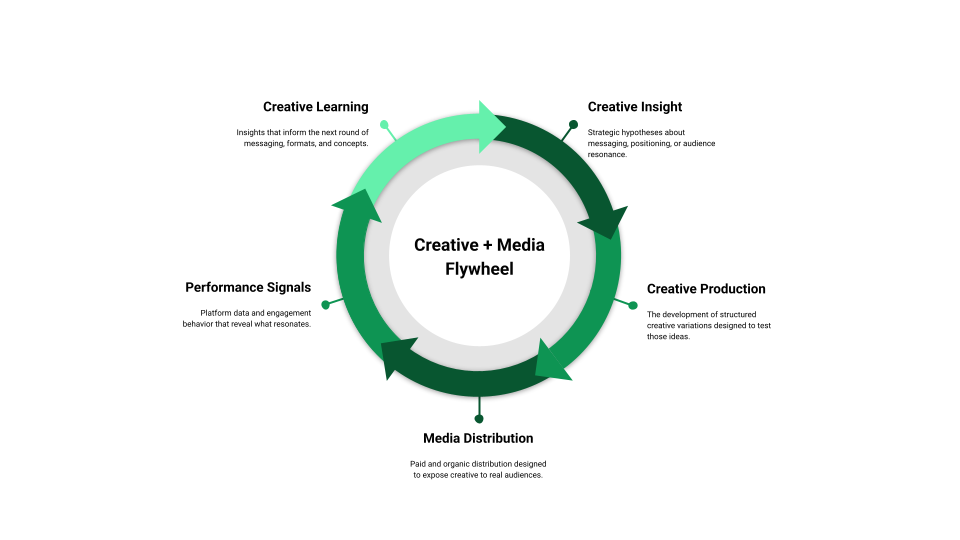
How the flywheel works
The flywheel isn’t a complicated concept. But it requires the two functions — creative and media — to actually operate as one system, which most agencies and in-house teams aren’t set up to do.
Here’s how each stage functions:
Creative Insight is where the cycle starts. Not with a brief asking for “three video options and two statics,” but with a genuine strategic hypothesis: we think this audience is motivated by X, and we’re going to test three ways of saying it. The insight drives the structure of what gets made.
Creative Production builds assets that are specifically designed to test that hypothesis — structured variations that isolate the variable you’re actually trying to learn about. Not creative for its own sake, but creative as instrumentation.
Media Distribution puts those ideas in front of real audiences at scale. Paid and organic working from the same brief, so the signals you’re collecting actually reflect a coherent test rather than random variation.
Performance Signals are where most teams stop — they read the numbers and file the report. In the flywheel, these signals are treated as the most valuable output of the cycle. Not just what performed, but what it means: which message angle won, which audience responded, which format earned attention past the first three seconds.
Creative Learning is the stage that closes the loop and makes the system compound. The insight from performance doesn’t sit in a deck — it lives in the next brief. It changes what gets made. It refines the hypothesis for the next round.
The flywheel doesn’t produce better individual campaigns. It produces a system that makes every subsequent campaign better than the last.
Why this works better now than it did five years ago
Three structural shifts have made the flywheel model more valuable — and made the old linear model more costly.
Algorithms now reward iteration. Modern ad platforms — Meta especially — don’t just deliver your ads. They learn from them. The account with a consistent creative input, regular fresh signals, and a coherent identity teaches the algorithm faster than one running big infrequent campaigns. Brands running flywheel systems give the algorithm more to work with, more often.
Creative is now the primary performance driver. As targeting has become automated and audience signals have weakened, the variable that actually moves results is the creative itself — the message, the hook, the story. The brands improving fastest are the ones learning fastest about what creative actually works, and why.
Distribution is no longer the constraint. Paid media, short-form platforms, and creator partnerships have made it easier than ever to get content in front of the right people. The bottleneck isn’t distribution. It’s structured learning — knowing what to say, to whom, and in what format, based on accumulated knowledge rather than a fresh guess each cycle.
In that environment, a learning system isn’t just a nice operational upgrade. It’s the primary source of competitive advantage.
What has to change to make it work
Building a flywheel isn’t just a process change — it requires creative and media to plan together from the start, which is genuinely different from how most teams operate.
Creative and media need a shared brief. Not a creative brief that gets handed to media after the assets are made. A single brief that defines the hypothesis, the distribution strategy, and the learning objectives before a single asset goes into production. What are we testing? How will we know if it worked? What will we do differently next round?
Creative has to be structured for learning. This means building deliberate variation into the asset mix — testing specific message angles against each other, isolating format variables, making sure the creative is actually instrumented to answer the question you’re asking. A batch of ten ads that all say roughly the same thing doesn’t generate much learning. A batch designed around three distinct hypotheses does.
Performance data has to feed back into creative strategy — not just reporting. This is the hardest part, and the most commonly skipped. The insight from last cycle needs to be in the room when the next brief is being written. Not as a footnote. As the starting point.
When those three things are in place, the loop closes. The flywheel starts turning.
Why most agencies can’t build this for you
The traditional agency model wasn’t designed for this. Creative agency, media agency, performance agency — three separate relationships, three separate processes, and almost no structural mechanism for the learning from media to get back to the people making creative.
This isn’t a criticism of the people involved. It’s a criticism of the structure. When creative and media are bought and managed separately, the feedback loop has to cross an organizational boundary every single time — and it usually doesn’t.
The brands that have built genuine flywheel systems either have deeply integrated in-house teams, or they work with partners who manage both functions as a single system. Not because integration is ideologically appealing, but because the loop doesn’t close any other way.
The compounding advantage
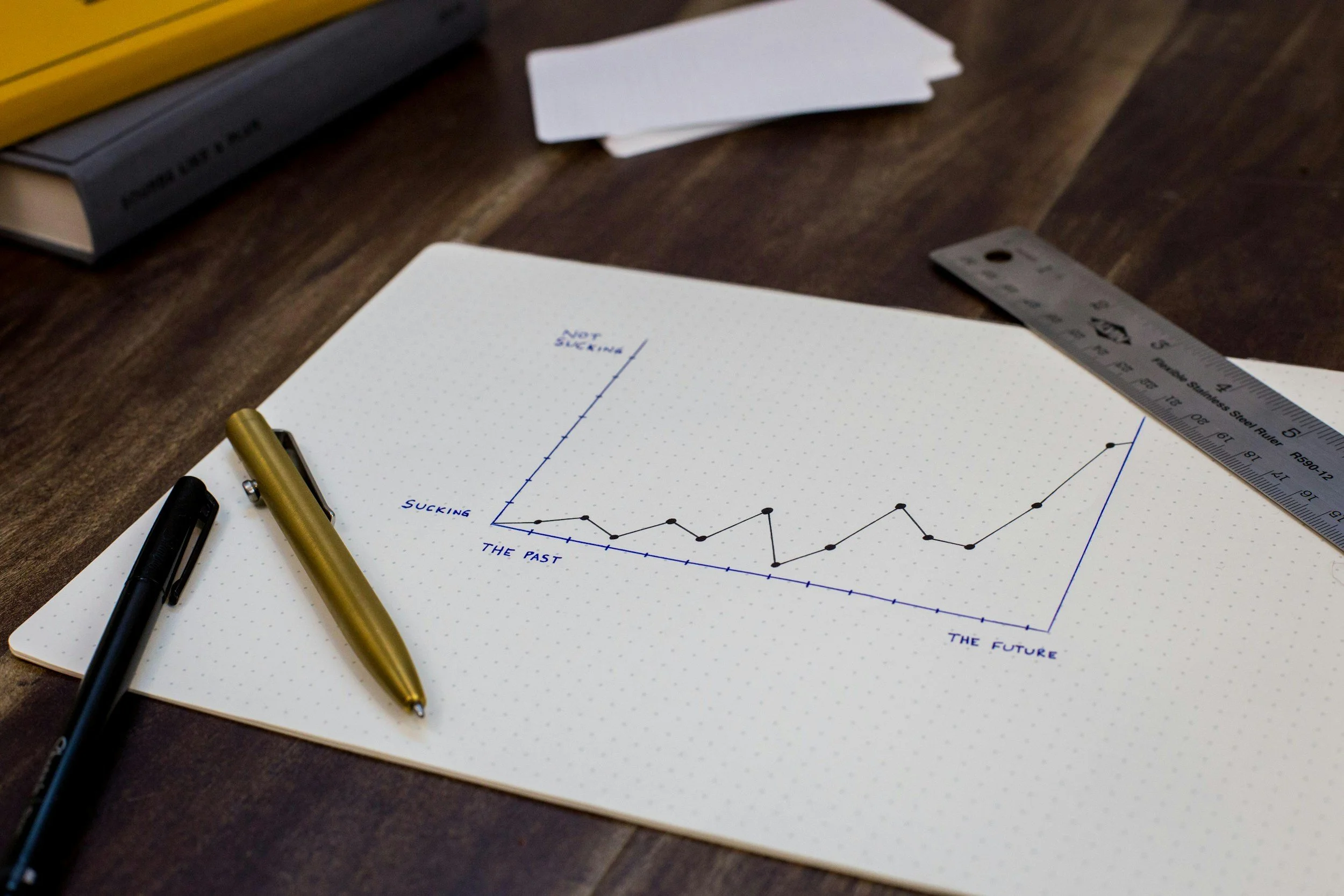
The reason the flywheel model matters isn’t just that it produces better campaigns. It’s that it compounds.
The first few cycles generate insights. Over time, those insights accumulate into something more durable: a real understanding of what your brand can say, to whom, in what format, to earn attention and drive action. Messaging improves. Hooks get sharper. Creative fatigue slows because you’re not guessing — you’re building on what you’ve learned.
Competitors can copy your best ads. They can match your spend. They can hire good creative people.
What they can’t easily replicate is a learning system that’s been running for twelve months. The compounding advantage of a flywheel isn’t in any single campaign — it’s in the accumulated knowledge underneath all of them.
That’s the structural edge. And it’s available to any brand willing to connect the loop.
If you want to understand what building this system looks like in practice, explore our Creative Production and Media Activation services — or get in touch directly.
The flywheel is the operating model. But it needs something to run on — a consistent identity, a clear point of view, and a content architecture that gives the system something to learn from. That's what a Brand Creator Identity is built to provide.